Our paper on nanoparticles has been accepted for publication (Feb. 07th, 2024)
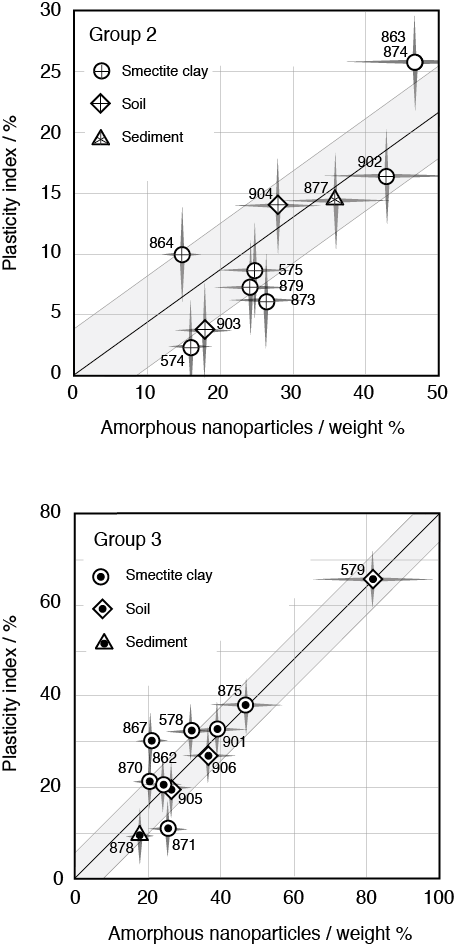
図は、非晶質ナノ粒子の量と可塑性因子が比例していることを表しています。つまり、粘土の可塑性の原因は、層状ケイ酸塩粘土鉱物ではなく、非晶質ナノ粒子なのです。
The figure shows that the amount of amorphous nanoparticles is proportional to the plasticity factor. In other words, it is the amorphous nanoparticles, not the layered silicate clay minerals, that are responsible for the plasticity of the clay.
ABSTRACT
A recent study using SAXS (small-angle X-ray scattering) revealed the presence of large amounts of amorphous nanoparticles in clays, soils, and sediments. In their analysis, all SAXS in the 2θ (Cu Ka) range of 0.12° to 8.00°, except for 001 reflection peak of smectite, was assumed to originate from amorphous nanoparticles. We have, however, shown that some parts of the SAXS come from grains of phyllosilicate clay minerals; the contribution from grains of phyllosilicate clay minerals is about 14 percentage for grains around 200 nm and about 3 percentage for grains around 1000 nm. We have also shown that the amounts of amorphous nanoparticles measured by SAXS are proportional to the specific surface area. This proportional relation confirms that large amounts of amorphous nanoparticles are really present in clays, soils, and sediments because the specific surface area of amorphous nanoparticles are very large compared with those of other minerals such as phyllosilicate clay minerals. This proportional relation also indicates that the amounts of amorphous nanoparticles are proportional to the plasticity index because specific surface area was known to be proportional to the plasticity index. Therefore, it is highly probable that the substance imparting plasticity is not phyllosilicate clay minerals but amorphous nanoparticles. If this is true, then the definition of “clay mineral” must be reconsidered.